
48: "The Conqueror" _ The Most Lethal Film of All Time?
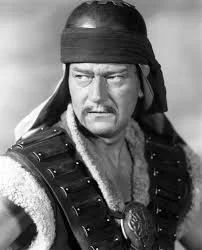
John Wayne as Genghis Khan
Born Marion Robert Morrison in Winterset, Iowa, in 1907, movie actor John Wayne had one of the most extraordinary film careers of all time. During his half-century in the movies 1926-1976), he either appeared or starred in 184 pictures. While certainly not a record (that belongs to Bess Flowers, the “Queen of the Dress Extras” who appeared in a whopping 1,124 films), Wayne held another, far more significant record: appearing in at least one film for 50 straight years. (Actually, he did not act in a movie in 1975, though both Brannigan and Rooster Cogburn were released in that year. Starting as a prop schlepper (along with his best lifelong best friend and fellow USC football star Ward Bond) on Tom Mix westerns, Wayne first appeared as an extra in the 1926 MGM silent film Brown of Harvard, starring Mary Pickford’s brother Jack and William Haines . . . two major stars of the day. During Wayne’s formative years, learning the ropes, an up-and-coming director named John (Jack) Ford kept his eye on the young Hawkeye, thinking that some day he might become a star. When, in 1930, the then 23-year-old Wayne jumped ship and starred in an expensive Western called The Big Trail, directed by Ford’s nemesis, Raoul Walsh, Ford washed his hands of Wayne . . . thus beginning 9 years of cinematic exile in which John Wayne played everything from singing cowboys (“Singing Sandy” to gigolos and pirates. In Ford’s mind, the problem with The Big Trail was not only that Walsh directed the film; it also showed in no uncertain terms that Wayne’s horse (“Duke”) was a better actor. The film was also a total flop at the box office, which didn’t help.
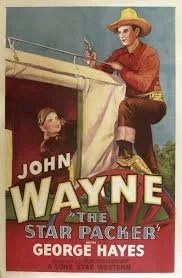
“The Star Packer” (1934)
From 1931 - the year after “The Big Trail” - until 1939 (when Wayne finally became a star playing “The Ringo Kid” in John Ford’s classic Western Stagecoach), Wayne worked his tail off trying to learn his craft and get back in Ford’s good graces. He made 6 movies in 1931, 11 in 1932, 11 in 1933, 9 in 1934, 8 in 1935, 7 in 1936, 5 in 1937, 4 in 1938, and 5 in 1939, the first of which was Ford’s Stagecoach. With the coming of WWII, Wayne traded in a horse for a tank and went off to single-handedly fight the Germans and the Japanese. By this point, he was a big box office star and becoming well-known for his outspoken arch-conservatism. And yet, he had no problem costarring in films with the likes of Henry Fonda (Fort Apache) and Kirk Douglas (The War Wagon, In Harm’s Way, and Cast a Giant Shadow), both of whom were outspoken liberal Democrats. Both Fonda and Douglas came to the same understanding with The Duke: never, never discuss politics.
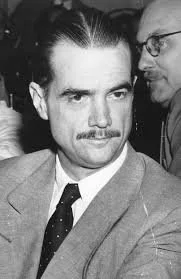
Howard Hughes (1905-1976)
In a career that spans a half-century and 184 years, John Wayne obviously made more than his share of stinkers and cinematic bombs - and often for bottom-of-the-barrel film companies. Perhaps the worst, most ghastly, was the 1956 Howard Hughes-produced atrocity, The Conqueror. Costarring Susan Hayward, Pedro Armendariz, Agnes Moorehead, and Pedro Amendarez, and directed by Dick Powell, The Conqueror tells the story of Mongol chief Temulin, who battles Tartar armies, falls in love with the Tartar princess Bortal, and eventually becomes the emperor Genghis Khan. Producer Hughes (1905-1976) was a billionaire businessman, film producer, director, noted hypochondriac, and world-class eccentric. At one time, he was considered a gifted producer/director, best known for Two Arabian Knights (1927), Hell’s Angels (1930), The Front Page (1931), and the original Scarface (1932). But as he aged, his films became far less frequent, overly costly, off-the-wall, and just plain awful. With 1956’s The Conqueror, he hit rock bottom; he would only make one more film after that: 1957’s Jet Pilot, for which he refused to take a credit.
Hughes’ bomb of a picture was shot in the Escalante Desert near St. George, Utah, which was 137 miles downwind from the United States government’s Nevada National Security Site and received the brunt of nuclear fallout from atomic weapons testing in the early 1950s. It turns out that three years before The Conqueror began production (1953), 11 above-ground nuclear weapon tests occurred at the Nevada test site as part of Operation Upshot-Knothole, the ninth series of atmospheric nuclear tests conducted by the Atomic Energy Commission. Although the area was contaminated by nuclear fallout, the Atomic Energy Commission assured Howard Hughes and the local population that the area was completely safe. Photographs exist of John Wayne holding a Geiger counter that reportedly made so much noise that he thought it was broken. After location shooting, Producer Hughes had over 60 tons of contaminated soil transported back to Hollywood in order to match the interior shooting done there.
Over the next 30 years, 91 of the 220 cast and crew members developed cancer. Forty-six died: Among the deceased were:
John Wayne, who passed away at age 72 from respiratory arrest and gastric cancer.
Nicknamed “The Brooklyn Bombshell,” Susan Hayward, once one of Hollywood’s biggest female stars, Hayward (born Edythe Marrenner), succumbed to brain cancer at age 57 on March 14, 1975.
Pedro Armendáriz, a legendary Mexican star known as “The Clark Gable of Mexico,” was a top box office attraction from 1935 to 1960. During the production of his 128th and final film, From Russia With Love (1963), he was diagnosed with terminal cancer. Ever the working actor, he had the schedule of production altered so he could finish his scenes in a timely fashion. He then went home and committed suicide. He had just turned 51.
Agnes Moorehead: originally a member of Orson Welles’ famed “Mercury Players,” Ms. Moorehead starred in some of the most historic radio dramas of the 1930s, and then went to Hollywood to have a leading role in Welles’ Citizen Kane. She received her greatest critical acclaim in Welles’ second film, The Magnificent Ambersons. An ebullient and versatile character actress, she was impossible to typecast. Of course, she was immortalized as Elizabeth Montgomery’s flamboyant witch-mother, Endora, on the popular TV show Bewitched. She died at age 73 from uterine cancer.
Dick Powell: a man who could do it all . . . musicals, film noir, Preston Sturges comedies, produce and direct. The Conqueror was the 3rd of 7 films he would direct. Dick Powell died of lung cancer at age 58 on January 2, 1963.