
#1,082 An Essential Challenge For We the People
Let’s face facts: For the past many years, We the People have been in the grips of an all-pervasive pall of malaise. We are uncomfortable; many are angry, hurt, and feeling abused. We fear for the future of both our once great nation and the world itself. Increasingly, we find ourselves making greater, more expressive use of our middle - rather than our index - fingers, and seeing villains and bogeymen lurking, not in the shadows, but in front of the cameras. A majority of us are sick and tired of being lied to. We long for a return to a time when our leaders - though mere mortals - were not public embarrassments. It is painfully obvious that our government - as well as many of its leaders - are bought, sold, and paid for by millionaires, billionaires, and - as of 48 hours ago - the planet’s first trillionaire. As a result of all this, we tend to seek simple solutions to complex challenges... or else sit on our hands and kvetch.
Want an example or two of the “simple solutions to a complex challenge” approach? Well, there’s ITs overly repetitively redundant insistence that just as soon as we win the war in Iran (which he first declared over as early as March 20 of this year), gas prices will immediately tumble and inflation will hit an all-time low. Then, there are all those who will tell you at the drop of a hat that once Democrats reclaim the House and Senate, 47 and his dastardly henchmen will be impeached, thus rescuing our imperilled democracy from the hands of traitorous autocrats, putting science and medical research back in the hands of the professionals, and restoring the nation’s reputation around the world. Sorry, but that’s not the way things work in a complex world.
Defeating troglodytic right-wing legislators who are beholden to special monied interests and replacing them with backbenchers more beholden to “we the people” is certainly a good start; however, beware - it is only a beginning. Putting Congress back in the hands of Democrats, independents and non-MAGA Republicans cannot and will not restock executive-branch departments that have been decimated and replaced by hacks whose only asset is total loyalty to a madman. It certainly will not replace professional, high-ranking officers who have been summarily fired for being the wrong gender or color. Restoring funding levels for public essentials like national parks, rural hospitals, emergency clinics, childhood vaccines, and USAID, cannot and will not happen overnight. Nothing is that easy.
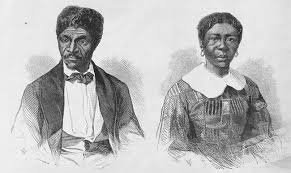
Dred and Harriett Scott
For longer than I can remember, I’ve been contemplating what the biggest challenge(s) is/are facing “We the People” might be when it comes to remedying our most toxic political maladies. The other day, while poring over some of my past political articles and essays, I came across a piece published in late October 2010, entitled Worse Than Dred Scott. (For those scratching their heads, Dred Scott was an enslaved black man who, along with his wife Harriet, sued for their freedom in St. Louis Circuit Court in 1857. They claimed they were free due to their residence in a free territory where slavery was prohibited. On March 6, 1857, Chief Justice Roger B. Taney read the majority opinion of the Court, which stated that enslaved people were not citizens of the United States and, therefore, could not expect any protection from the federal government or the courts. The opinion also stated that Congress had no authority to ban slavery from a federal territory. This decision moved the nation a step closer to the Civil War. Ever since, American historians have considered this to be the worst decision in the history of the Supreme Court. )
Worse Than Dred Scott was a 1,350-word piece on the then-recently decided Citizens United v. Federal Election Commission case. The case (558 U.S. 310 (2010), which the court decided by a 5-4 vote on January 21, 2010, “... limited expenditures on political campaigns by groups such as corporations, labour unions, or other collective entities violates the First Amendment because limitations constitute a prior restraint on speech.” In other words, what SCOTUS did in its ruling was fundamentally alter American elections by allowing corporations, unions and wealthy individuals the legal right to spend unlimited amounts of money on political campaigns. Hence, the title of that essay meant to state upfront that, in my opinion, Citizens United v. FEC was replacing Dred Scott as the worst decision in our history. I found the original article on my hard drive, but could not bring it up on the internet. I did, surprisingly, find an AI-generated discussion of it . . .
What made - and still makes - the Citizens United decision so politically lethal are some of its ancillary “benefits”
Creating Super PACS: The ruling paved the way for “Super PACS,” which raise and spend infinite sums of money to influence elections. While they cannot technically coordinate directly with candidates, critics argue that this firewall is frequently breached.
Rise of "Dark Money": It facilitated a massive surge in "dark money," allowing wealthy donors and corporations to funnel tens of millions into elections through non-profit organizations that are not legally required to disclose their contributors.
Distorted Representation: Unlimited spending by billionaires and corporate interests drowns out the voices of everyday voters. This system forces elected officials to become overly beholden to elite donors rather than their constituents.
Unfair Competition: Because the Supreme Court ruled that corporate spending is protected speech, deep-pocketed entities can effectively buy massive amounts of political advertising, making it incredibly difficult for underfunded, grassroots-supported candidates to compete.
At this point, I can hear your question: “So how in the hell can we get rid of Citizens United? Wouldn’t doing so tend to put politics back on a more level, moral plane? The answer to the second question is, “I personally believe so.” Without all that anonymous gelt pouring into campaign coffers, candidates and incumbents might have to return to the historic job of serving their constituents’ needs, rather than their donors’ demands. So far as the first question - about expunging or overriding the Court’s Citizens United decision - the answer is, surprisingly, a bit more objective, but a whole lot more complex.
From the point of objectivity, polls from various organizations, including Bloomberg and Issue One, have shown widespread disapproval of the Citizens United decision. As of 2025, 22 states and hundreds of local governments have passed resolutions calling for a constitutional amendment to reverse Citizens United. Within Congress, Senator Adam Schiff (D-CA), Dean Phillips (D-MN), Pramila Jayapal (D-Wash.), and Jim McGovern (D-MA) have repeatedly introduced the Democracy For All Amendment to the Constitution. It would overturn legal precedents that have allowed unrestrained campaign spending and dark money to corrupt American democracy. According to the Center for Public Integrity, “Three quarters of survey respondents - including 66% of Republicans and 85% of Democrats - back such an amendment.” Unfortunately, amending the Constitution of the United States is a terribly difficult procedure. The Founders meant it to be that way.
(n.b. In our entire history, only 27 of the thousands upon thousands of amendments that have been proposed have met the strict two-thirds congressional approval and three-fourths state ratification requirements as outlined in Article V of the Constitution. The first ten of those amendments were passed on a single day (September 25, 1789), and one of the 27 (#18, the Volstead Act banning the manufacturing or sale of alcohol) was overturned a mere 14 years later [December 5, 1933] by the 21st Amendment.)
For generations, conservatives were far more “states’ rights” oriented than progressives. What they, the conservatives, feared the most was that giving too much power to the feds would, in the long run, put a roadblock on things they - the states’ righters - cared the most about . . . like slavery, lower taxes, a strong national defense, and what could and could not be taught in public schools. Fascinatingly, over the past several years, when it comes to supporting their most pressing issues, conservatives have begun putting more and more faith into the feds than the states. It is their feeling that an overwhelmingly conservative Supreme Court will, in the long run, be able to turn back the tide of state courts and legislatures. And perhaps, just perhaps, they can elect a POTUS who doesn’t really care about the Constitution.
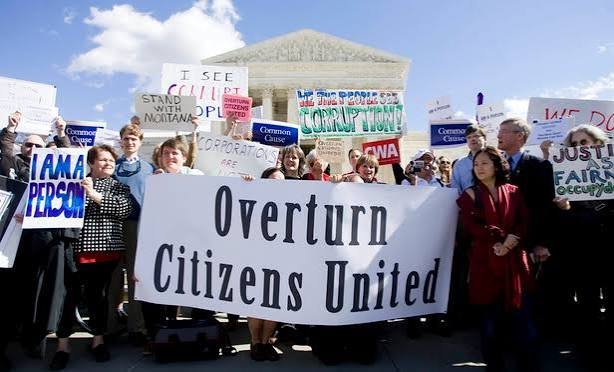
A Rally at the Montana State Capitol
So maybe Democrats, progressives, and independent voters should start looking to the states when it comes to something as evil as Citizens United. Believe it or not, the Great State of Montana has been doing just that. A little over 2 months ago, the Montana Supreme Court dismissed a challenge from a coalition of business and industry groups over a proposed ballot initiative seeking to limit corporate spending in Montana elections. In a unanimous decision, the court said reviewing the constitutionality of an initiative is “disfavored” because Montanans have a right to go through the initiative process. The statutory initiative, dubbed “The Montana Plan,” would create a new Montana law to prohibit corporations - known in law as “artificial persons" - from spending money on political candidates or ballot issues. The Montana Plan is, of course, a direct challenge to Citizens United. Should enough Montanans sign the petition to put Ballot Issue 10 on the ballot this November, then the Big Sky will become the first state to eliminate Citizens United from doing its thing on its home turf.
And we can also add Hawaii to the list: less than 5 weeks ago, the Hawaii legislature passed S.B. 2471—a bill by which the 50th state would no longer grant artificial entities, including corporations, the power to spend in Hawaii’s politics. It passed both chambers with overwhelming bipartisan support. Governor Josh Green has said he will sign it. S.B. 2471, which is based upon the Center for American Progress’ “Corporate Power Reset,” is not a regulation of speech. It is a redefinition of corporate power.
How’s that for an idea and an inspiration? Instead of attempting to eliminate Citizens United from the top down (e.g., at the federal level), start at the state level and work your way up. We have seen that when We the People get really riled up (such as the “No Kings” movement), we come out in droves to protest against The Regime and political corruption. So why can’t we do the same with a nationwide End Citizens United protest?
My strong recommendation is that, instead of sitting back and kvetching, we contact our local city council members, county commissioners, and state legislators and create petitions to put anti-Citizens United initiatives on state ballots.
We have nothing to lose . . . and everything to gain. It is a supreme challenge that can pay enormous dividends.
Copyright©2026 Kurt Franklin Stone


