
#1,085: Hyam Salomon: Son of Liberty
In a recent national survey conducted by the Cato Institute, 46% of Americans polled did not know that the Fourth of July commemorates the adoption of the Declaration of Independence. This civic knowledge gap was particularly pronounced among younger demographics, with 61% of Gen Z respondents unaware of what the day celebrates. Ouch!
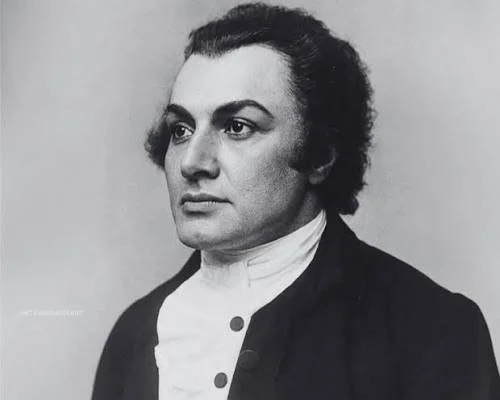
Hyam Salomon: Financier
In last week’s pre-4th of July blog (Some Thoughts on America’s Semiquicentennial), we spent time with 3 Founders whose names are known to one and all: Thomas Jefferson, John Adams, and Dr. Benjamin Franklin. Today, I would like to spend some time with one of the least-known (and most essential) of our founders: the Polish-born Sephardic Jew, Haym Salomon (1740-1785), who was the Revolutionary War’s financier. Without the likes of General George Washington, Gilbert du Motier (the Marquis de Lafayette), and General Nathaniel Greene, the colonists would never have defeated the British on the various battlefields. Without Salomon, there wouldn’t have been any funding for that historic victory; no guns, no ammunition, no uniforms, no horses or grain, no food or blankets for the troops, and no money to send to the folks back home.
Although born in Leszno, Poland, in 1740, Hyam Salomon’s family was Sephardic. After being expelled from Portugal in 1492, they made their way first to Germany, and then, when it became too dangerous, moved further east to Poland, where Hyam was born shortly after their arrival, on April 5, 1740. Born into a middle-class family, highly educated Salomon traveled widely throughout Europe, learning the merchant’s trade and becoming fluent in at least 7 languages, including German, Russian, Polish, French, Spanish, Ladino (the Sephardic version of Yiddish), and perhaps most importantly, unaccented English. His travels throughout Europe as a merchant and broker broadened his worldview and gave him a deep understanding of international finance. He also witnessed firsthand the persecution of Jews across the continent, which helped shape his belief in liberty and tolerance.
By the early 1770s, seeking greater opportunity and freedom, Salomon emigrated to New York City, then one of the busiest ports in the British Empire. There, he established himself as a successful merchant and financial broker, quickly becoming a respected member of the city’s small but influential Jewish community. After nearly a year in New York, he moved on to Philadelphia, where he married, started a family, joined the Sephardic Mikvveh Israel synagogue, which had been founded in 1740 (the year of his birth), and was accepted as a member of the Philadelphia branch of the super-secret Sons of Liberty. This was the grassroots, paramilitary organization formed in 1765 to protect colonists' rights and fight British taxation without representation. Best known for orchestrating the 1773 Boston Tea Party, their acts of defiance were instrumental in sparking the American Revolution
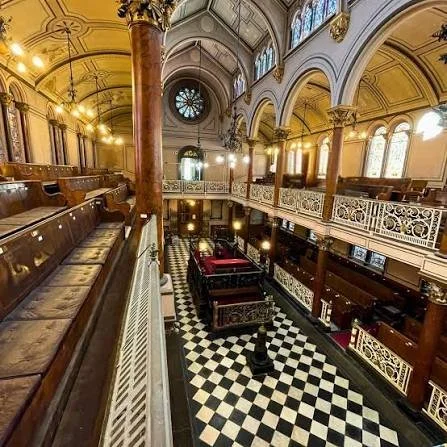
Congregation Mikveh Israel
N.b. Although it moved and was rebuilt shortly after Hyam Salomon first became a member of Mikveh Israel, its current location makes it the longest-continuously operating Jewish congregation in the United States.)
Exposed and arrested for being a member of the Sons of Liberty (which the British considered a terrorist organization), Salomon was arrested and imprisoned. When the British military command learned of Salomon’s extraordinary language skills, they released him in exchange for his promise to act as a secret agent on their behalf. This he agreed to do; this he never did. He would be arrested once again about a year later, only to escape and go into hiding.
By this point, Salomon was already raising money for the Continental Army. The story is told that one Erev Yom Kippur, while attending services, he received a sealed missive from General Washington, informing Salomon that the army was in dire need; they must have an infusion of at least $650.000 (about $20 million in 2026 dollars) Washington wrote, or their cause would be lost; troops were threatening to walk off the battlefield unless they had warm clothes, more ammunition and a few pounds to send back to their families. Salomon managed to raise over $50,000 from his fellow congregants . . . payable right after the conclusion of Yom ha-Kippurim. In addition to Salomon, other prominent members of Mikveh Israel making substantial donations were Col. Mordecai Sheftal (1735-1797), the highest-ranking Jewish officer to serve in the American Revolution and, his cousin Sheftal Sheftal; Gershom Mendes Seixas (1745-1816), the first native-born Jewish leader in the United States; Dr. Phillip Moses Russell (1747-1830), Washington’s personal surgeon at Valley Forge; and prominent businessman Jonas Phillips (1736-1803) who was the first to contribute. In all, the members of Mikveh Israel and the Jewish communities of New York, Rhode Island, South Carolina, and Georgia raised untold thousands of dollars, thus giving General Washington’s urgent fundraising plea a great start. And mind you, in 1776, when the population of the 13 colonies stood at approximately 2.5 million, the Jewish population was a mere 2,500; less than .0008%
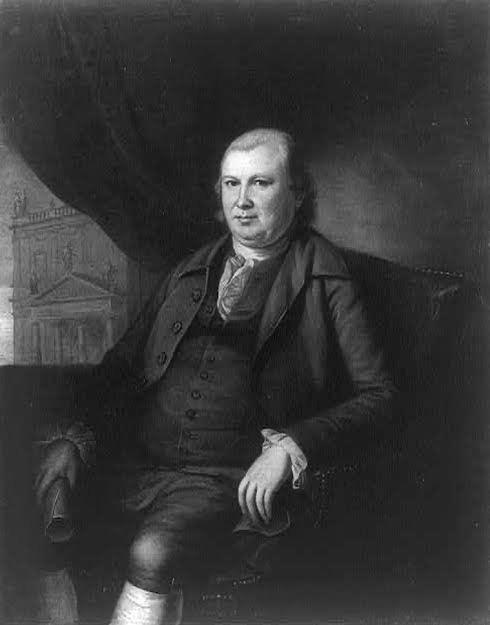
Robert Morris (1734-1806)
Salomon quickly got in contact with Robert Morris, a Liverpudlian by birth who, by 1775, was reputed to be the richest man in the colonies. In 1775, while serving as a representative from Pennsylvania to the Second Continental Congress, he was named Superintendent of Finance to oversee financial matters in the colonies. Morris accepted this appointment and also served as “Agent of the Marines”, from which he controlled the Continental Navy. Hyam Salomon knew that if he were to succeed at the task urged upon him by General Washington, he would need Morris by his side. As things turned out, Morris, who is slightly better known than Salomon today, was one of only two people - the other being Roger Sherman of Connecticut -who signed the Declaration of Independence, the Articles of Confederation, and the U.S. Constitution. He was also a Senator from Pennsylvania from 1789-1795)
The two worked very well together. Salomon’s job was largely traveling back and forth between the colonies and Europe, where he brokered Continental bills of exchange for hard currency. For this exhausting task, he charged an inconsequential quarter of a percent for his services - mostly for his travel expenses. (While researching my first book about the Jews of Congress [2003’s The Congressional Minyan], I learned that Salomon also made interest-free loans to many of the Founding Fathers [Jefferson, Monroe and Madison] for the purchasing and/or upkeep of their family estates - all of which today are on the list of National Historic sites.)
It is estimated that Salomon raised in excess of $650,00.00 (c. $20 million in today’s money). And when this turned out to be less than was required, he gave unstintingly of his own personal fortune. So much so that upon his death in 1785 at age 44 (tuberculosis), he owed his creditors in excess of $650 K. Ironically, when he died in 1806, Robert Morris was also intestate. However, the reason(s) for his financial problems was/were bad investments, not being overly generous.
Salomon’s heirs, despite more than nearly 2 centuries of trying, never managed to be financially reimbursed for their progenitor’s patriotic largesse. In the years after Hyam’s passing, a couple of forms of public acknowledgement did come his way:
In 1939 (Hollywood’s greatest year . . . the one in which they could “do no wrong”), Warner Bros released a two-reel (20:44 minutes) short entitled “Sons of Liberty, starring the magnificent Claude Rains as Salomon, and Academy Award-winner Gayle Sondergaard as Hyam’s wife Rachel. Directed by Michael Curtiz (the best director on the Warner Bros.’ lot), from a script by the former silent actor (Crane Wilber), it was, for 1939, an extremely gutsy movie to create and screen. It was so well received by the industry that it won an Academy Award for the best 2-reel short of 1939. What made it so unique and heroic was that in 1939, few, if any, studios were producing pictures realistically depicting Jews. Sons of Liberty made no bones about the fact that one of America’s Founding Fathers was a practicing Orthodox Jew, and actually portrayed scenes in which he was davening and wearing a tallis.
There are those who have long contended that the geometric figure floating above the eagle’s head in the Great Seal of the United States is a Star of David, placed there in memory of the Jewish broker who kept the nation’s finances afloat, and,
On December 15, 1941, the Heald Square in Chicago (which includes the statue of Haym Salomon alongside George Washington and Robert Morris) was officially dedicated and unveiled, finally recognizing the two Founders most responsible for raising the funds to underwrite the most significant rebellion in all modern history.
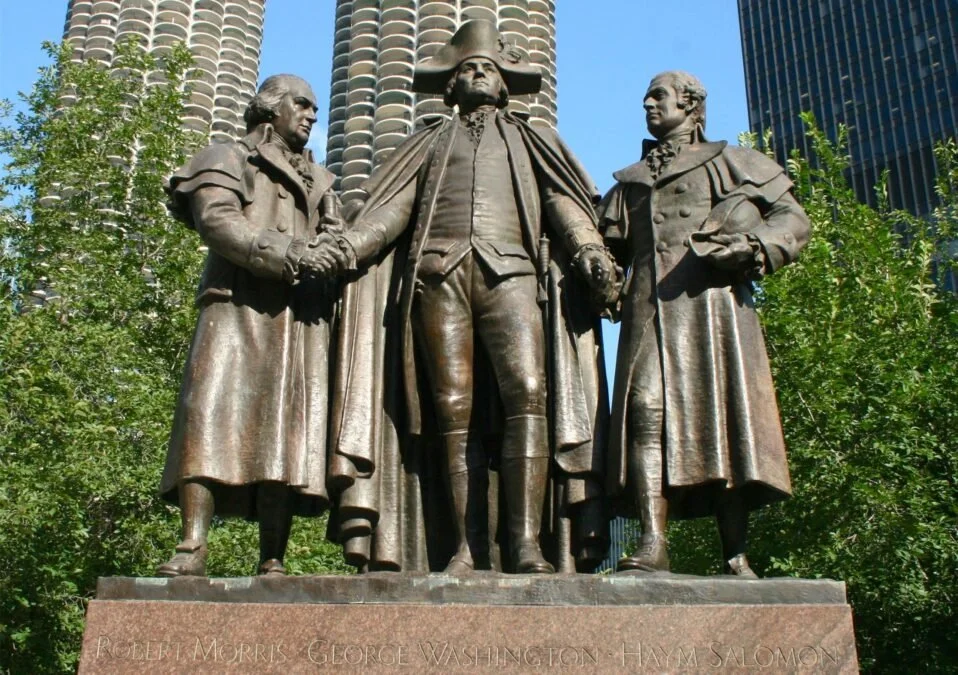
On this, the 250th anniversary since the signing of the Declaration of Independence, please remember the importance and central role that Hyam Salomon and one teeny-tiny kahal (community) played in creating this great, great nation . . .
Happy 250th, one and all!
Copyright©2026 Kurt Franklin Stone