
#1,084: Some Thoughts on America's Semiquincentennial
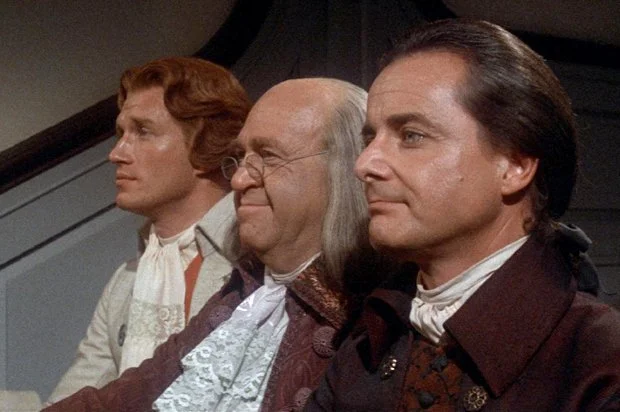
“Jefferson,” “Franklin” and “Adams” in “1776”
The last time I participated in a large outdoor 4th of July celebration was for America’s Bicentennial, July 4, 1976. I well remember that one: it took place at Camp Hess Kramer in Malibu, California, where I spent the summer as the camp rabbi and songleader. The camp is located just a stone’s throw from the Pacific Ocean, a heavenly spot for a summer camp. It was a great 4th of July: the hot dogs were delicious, the music quite loud, and the fireworks utterly breathtaking. At that time, Gerald Ford was POTUS, Nelson Rockefeller was V.P., and a gallon of gas cost anywhere between .59¢ and 61¢ (that’s $3.46 to $3.58 a gallon when adjusted for inflation in 2026). For those who have a vivid recollection of the time, getting a fill-up was quite a bit more expensive than what we had been accustomed to paying just a year before; what made matters even worse was that it took anywhere between 45 and 65 minutes just to get to the pump . . . we were undergoing a drastic shortage of gas, thanks in the main, to OPEC.
The fact that I never attended another mass outdoor 4th of July gathering after the Bicentennial had nothing to do with politics; it was mostly a matter of climate. It just turned out that South Florida weather was too hot and, G-d knows, too temperamental and inconsistent for being outside, sweating on a picnic blanket. Instead, Annie and I created the tradition of watching the classic film musical “1776,” based on the book and screenplay by fellow Angelino (though totally unrelated) Peter Stone (née Sturmwasser) and directed by Peter Hunt. Although not 100% historically accurate (what Broadway play, historical novel, or movie ever is?), it has always filled us with pride and amazement at how many brilliant, accomplished, worldly, highly educated men there were in 1776 who could cobble together that miracle known as the United States of America. (n.b. The 3 actors in the photo above are, right to left, Ken Howard [Thomas Jefferson], William Daniels [John Adams], and the formerly blacklisted Howard Da Silva as Dr. Benjamin Franklin.) Then, after dabbing our eyes and feeling pride in our khiskes, we go out onto our covered back porch and watch the fireworks ascending from a park in Boca Raton.
In talking with people in our neighborhood about their plans for the upcoming 4th, quite a few of the conversations have turned to the current political landscape. And mind you, most of our neighbors don’t know the first thing about my involvement in politics or that I have been writing this blog for more than 20 years. Many say that they just can’t get terribly excited about America’s Semiquincentennial because they hate the president, they hate MAGA, they hate the Democrats . . . they hate, hate, hate. When I hear someone gearing up to tell me how bad things are as compared to the last major American anniversary (1976 - the Bicentennial), I wonder just how much they know about our history. I mean, we are celebrating the history of a country, not the current moment or cast of characters.
As a country, we are about to observe our 5th golden anniversary. And you want to know something? July 4, 1826, 1876, 1926, 1976, and 2026 have all had their historic problems amid celebration. Let’s take a quick trip back into American history:
July 4, 1826: Without question, America’s 50th anniversary was just downright eerie. The country was in the throes of the Missouri Compromise, where the country had its first major sectional crisis over slavery. It had to be on everyone’s mind. And just two years earlier, there was an extremely bitter presidential election in which, famously, Andrew Jackson, who, despite receiving the most popular and electoral votes, lost the election when it went to the House, which gave the stamp of approval to John Quincy Adams. Talk about political divisions in the country!
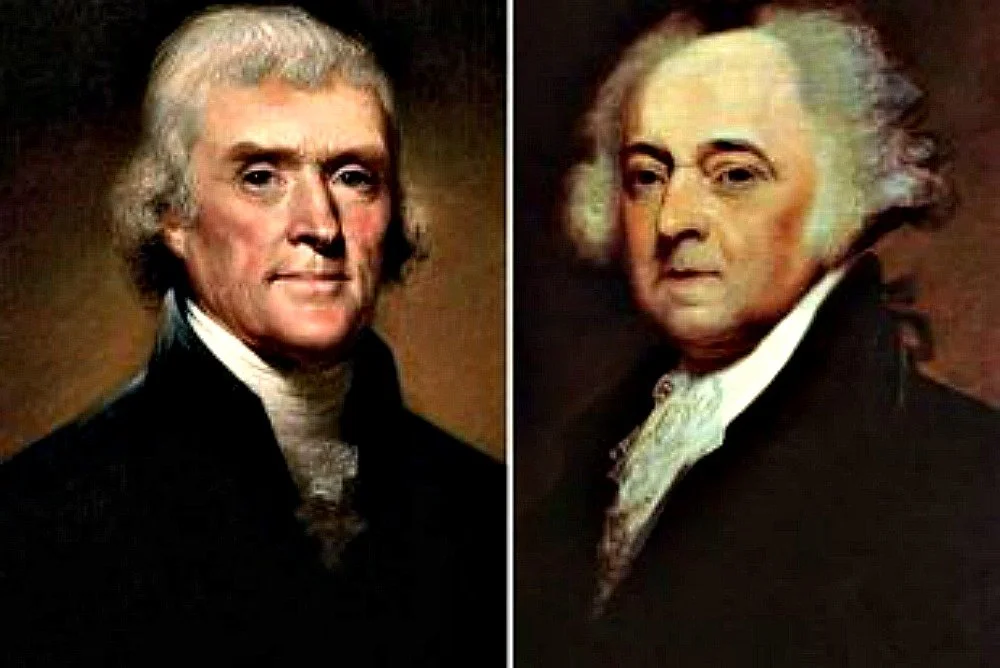
Jefferson and Adams: American Pen Pals
July 4, 1826, was also one of the most unique, downright bizarre days in all American history. For on that day, at around 12:50 p.m. Thomas Jefferson, America’s 3rd president, passed away at his home in Virginia. He was 83. Five hours later, up in Massachusetts, John Adams, America’s 2nd president, passed away at the age of 90. Adams’ last words were reportedly either "Thomas Jefferson survives,” or "Thomas Jefferson lives.” How remarkable that the two should both pass away precisely on the day America was celebrating their greatest mutual achievement: The Declaration of Independence. Shortly thereafter, the two - who had worked hand-in-hand during the Revolutionary War - saw their relationship disintegrate over their highly differing views on the power of the federal government: Adams favored a strong, centralized national government to maintain stability; Jefferson, fearing centralized tyranny, advocated for strong states’ rights and an agrarian society. Eventually, a mutual friend, Dr. Benjamin Rush (who also signed the Declaration), put the two back together after 12 years of silence. In 1812, Dr. Rush urged the two to reconcile. Eventually they did, although they never again saw one another face-to-face. They did, however, begin a 14-year correspondence in which they exchanged well over 150 letters on subjects ranging from politics and history, literature and philosophy . . . even the parsing of Hebrew passages from the Bible. To read their letters is akin to being privately tutored by two of the most civilized, highly-educated people in all American history.
July 4, 1876: This is the year we tend to mark the end of Reconstruction. Lasting from 1861 to 1900, this is the historic period in which the United States grappled with the question of how to integrate millions of newly-freed African Americans into social, political, and labor systems. At the time of America’s centennial celebration, there were still ongoing acts of horrific political violence going on in the South. America was still, largely, a divided nation.
July 4, 1926: At the halfway point of the “Roaring Twenties,” America was in the midst of yet another gilded age. While movie stars like Chaplin, Fairbanks, Pickford, and Swanson were earning more than $20K a week ($191K in today’s money) the stock market was soaring, and the Ford Motor Company became the first major corporation to officially adopt a 5-day, 40-hour work week, Congress was passing the notorious Johnson-Reed Act that established strict national-origins quotas and completely excluded immigrants from Asia. It aimed to drastically reduce the flow of immigrants, primarily from Southern and Eastern Europe. The law limited the number of immigrants allowed entry per year to 2% of the total number of people of any nationality living in the U.S. as of the 1890 census. This act would not be officially repealed until passage of the Immigration and Nationality Act of 1965. And you think today’s immigration situation is bad?
July 4, 1976: In the midst of a Swine flu epidemic, and still reeling from the resignation (and eventual pardon) of Richard M. Nixon, the United States, at the time of its Bicentennial celebration, had an average Misery Index (Unemployment + Inflation rate) of 16.00. (By comparison, the Index averaged 8.83 under Barack Obama, and a slightly higher 10.15 under Joe Biden.) Inflation stood at 5.76%, and a 30-year fixed mortgage at 8.87%.
July 4, 2026: At the time of our Semiquincentennial, America feels like a country that has lost its way. Every hour seems to bring breaking news about some embarrassment emanating from the White House or Capitol Hill. There is a yawning chasm of difference between haves and have-nots. We are saddled with a president who is sinking further and further into the quagmire of insanity and, instead of draining a swamp, has turned a once beloved reflecting pool into one. He presides over an administration whose incompetent accomplices are there for accomplishing precisely two tasks: buoying up their master’s massive ego, and unquestioningly supporting his polymorphous perversity.
To many, it seems that we are far, far worse off, far too retrograde than we were at the time of the nation’s Bicentennial. Guess again. While it is certainly true that these are not the best of times, we have, nonetheless, come a long, long way. Consider:
In 1976, no woman had ever been appointed to a seat on the Supreme Court. Today alone, there are 4 (Justices Sotomayor, Kagan, Barrett, and Jackson);
In 1976, the 94th Congress (January 1976-October 1, 1977), only 18 women were seated in the House - 17 of whom had the right to vote. Today, in the 119th Congress, there are 155 women, representing 28% of the legislature; 128 women in the House (including 4 non-voting delegates) and 26 in the United States Senate.
In 1976, there was but a single woman serving as a governor: Ella Grasso, a Democrat in Connecticut. In 2026, there are a record 14 women serving as state governors - 10 Democrats and 4 Republicans.
And while it may seem that our current POTUS (aka the “Fondling Father”) is having his way in virtually everything, consider that of the 176 times he has been sued in court, he has come up short nearly 80% of the time.
For all those who say it is next to impossible to celebrate the 4th of July with a full heart, remember several things:
We are neither celebrating a moment in time nor a particular president .. . but rather a country that has been a miracle since the days of Jefferson, Adams, Franklin, and their colleagues;
While the current POTUS wants, with every fibre of his being, to act like a king, he is still faced with the system of checks and balances first created by the Founders. and,
While DJT may be the POTUS, America - and “we the People” - are still the realities that keep him from being the King he wishes he were.
Bring on the fireworks of freedom! We have much to celebrate . . . whether from our porch out back or in a municipal park.
Copyright©2026 Kurt Franklin Stone