
#1,078: "Perfection is the Enemy of Progress"

Francois-Mariet Arouet (Voltaire) 1694-1778
As I sit down to begin writing this blog, America’s midterm elections (Tuesday, November 3, 2026) are 176 days away. Needless to say (or write), even before what looks to be an historic date, scores of votes will have been cast either through surface mail, electronic means, or early visits to the nation’s innumerable local polling sites. (Whether or not some of these sites will host armed ICE agents remains to be seen.)
Keep in mind that depending on the source from which one gleans their political prognostications, the final tally might hand both the U.S. House and Senate over to the Democrats, keep the Senate in Republican hands, or - g-d forbid- be called off due to some utterly fictional “state of emergency.” Such a range of possibilities suggests a pithy truism from the French aphorist and novelist Voltaire: “Le mieux est l'ennemi du bien," generally translated as “The best is the enemy of the good," or, as Sir Winston Spencer Churchill translated it, “Perfection is the enemy of progress.” But more on this later. . .
If recent elections provide teachable moments, one may assume that any Republican loss will be declared the product of base political trickery on the part of the Democrats . . . or that any Republican victory (regardless of margin of said victory) will be declared a "landslide of epic proportions.” Ah, shades of Antonio in Shakespeare’s The Tempest: “The past is prologue,” meaning that history sets the stage for both the present and the future. (BTW, this is the phrase notably inscribed on the National Archives building in Washington, D.C.) For those who might wonder what the oldest government record held in that neoclassical “temple to American history” might be, put on your seatbelt: it is the eerily named Doomsday Book (actually, there are two of ‘em: Little Doomsday and Great Doomsday), which contains a tremendous amount of information about England in the 11th century.
Speaking of “doomsday,” up until less than 2 weeks ago, it looked like the next volume of the ancient text would be written by Republicans facing a congressional bloodletting in the House and perhaps even the Senate. Up until the last days of April, Democrats were feeling increasingly emboldened about taking over control of the House after seeming to have fought the redistricting wars to a draw. In state after state, and lower court after lower court, Republican attempts to rid their states of Black-, Hispanic- or Progressive-leaning congressional and state legislative districts were meeting with nothing but failure. And, in special-election-after-special-election, Democrats were manhandling Republicans for seats in both Congressional and state legislative districts . . . districts which NACHO had handily won in 2024.
But two court rulings — one by the United States Supreme Court (Louisiana v. Callais) and another by Virginia’s top court — and an aggressive new push by red states to carve up congressional maps, have delivered the Republican Party its biggest burst of momentum in many months. Bluntly put, Republicans have roughly 10 more House seats that favor them than they did just 10 days ago, and Democrats are suddenly grappling with a new landscape. And although Democrats are still widely seen as favored to win the House this fall, Republicans face a daunting political climate, saddled with POTUS’ sagging approval ratings, high gas prices, and an unpopular war with Iran. In special elections and last year’s races for governor, Democratic enthusiasm has swamped Republican turnout.
Indeed, the last 10 days have demonstrated the power and speed of the courts to shape the midterms — and the role of judges in the next phase of the redistricting battle. Recent legal actions are underway in Virginia, Tennessee, Florida, Louisiana, and Alabama that could still undo or block some of the potential Republican gains before the fall.
The outcome of the legislative and legal fight, which has unfolded largely beyond the control of American voters, could be highly consequential. No party has made a net gain of more than a dozen House seats in a national election since the wave of 2018.
So, what can those Americans who truly fear a future with a Republican Congress, Senate, governorships, and various state legislatures do? Making financial contributions to Democratic candidates is always a good idea . . . although beyond the means and habit patterns of many.
Another suggestion – which costs virtually nothing to accomplish: contact your local election office (they go by different names in different places) and make sure you are still eligible to vote. Please, do not wait until the last minute. With the way things have been going of late, it’s just possible that you could get to the polls and find your right challenged - or what’s even worse - denied. So go online, pick up the phone, send an email, and make sure you’re still on the books. Taking care of this within the next several days will also give you the time you need to locate any documentation you may be lacking. And while you’re at it, please make sure you are set up to receive a sample ballot by surface or email. There is nothing worse than trying to figure out who you’re going to vote for (or where you stand on ballot issues) when you get to the polls. Do your homework before leaving home!
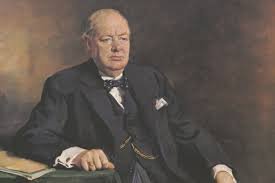
Winston Leonard Spencer Churchill (1874-1965)
In doing my prep work for this blog, I’ve found myself thinking a lot about Winston Churchill, who, as mentioned in the second paragraph of this piece, retranslated Voltaire’s “teachable moment” as “Perfection is the enemy of progress.” What does Sir Winston’s quip have to do with the upcoming midterm elections? In a word, plenty.
In most democratically elected systems, political primaries tend to attract candidates from each party’s full spectrum, from farthest right to farthest left, and from single-issue ideologues to their most centrist realists. Problems can occur when enough people vote for (or against), say, a single-issue candidate, thus denying a primary victory to someone who may actually stand a chance of gaining victory in the November general election. We are seeing this political phenomenon across the country in key Senate and House races, where Democratic primary voters are being presented with nominees who are more progressive or moderate than they, the voters, are, and who may have discrete positions that unsettle them. Or, what veteran New York Times opinion writer Frank Bruni refers to as “individual warts that offend them [or] biographies that aren’t to their liking.”
In a recent opinion piece, Bruni cited a couple of these, most notably the Maine Senate race, where Democratic candidate Graham Platner may not stand as good a chance of defeating 6-term incumbent Senator Susan Collins, as would have Governor Janet Mills, who essentially ceded the Democratic nomination to Platner last week. The problem with Platner? About all the voters know about him - and what Republicans will no doubt incessently remind voters about between now and November - are a couple of non-issues: that Platner has never held office before, has a bit of a public temper, once sported a Nazi tattoo (now gone), and has a fondness for “gay” and “gayest” as put-downs, in his not-so-distant past. Collins, on the other hand, will remind voters over and over again that she is a “moderate” Republican who has, from time to time, gone against POTUS. (Actually, Collins’ moderation is more by way of reputation than reality; she has shown herself to be an undependable check on Felon47. The issue here is not whether Platner is perfect; it’s whether or not Mainers are terrified enough of MAGA and the regime to get rid of a senator who possesses neither the guts nor the courage to help save the country by standing up against the worst, most incompetent, most morally and intellectually bankrupt POTUS in history.
It seems to me that in deciding who to cast a primary vote for in the coming weeks, two things are of utmost importance:
Will my candidate be able to defeat the Republican in November, and
Will my candidate successfully call out IT and members of his regime, thus saving the country from grifters and gangsters who make us the laughingstock of the world?
Save perfection for the world-to-come and the 1972 Miami Dolphins. Please, I beg you, in the name of Voltaire and Churchill:
DON’T LET THE PERSUIT OF PERFECTION BE THE ENEMY OF PROGRESS!
Copyright©2026 Kurt Franklin Stone