
#1,100: The Wisdom, Humanity, and Foresight of Mark Twain
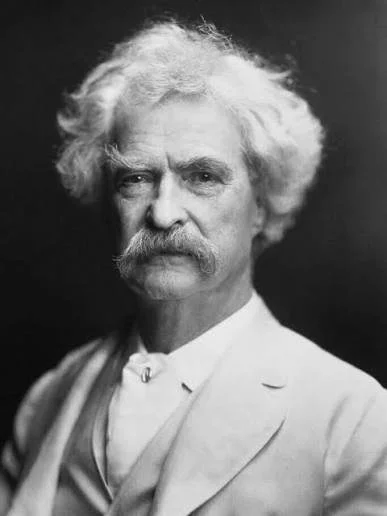
Mark Twain: Novelist, Essayist, Mentsch (1835-1910)
Despite being a relatively young country, America has produced many great writers: Hawthorne, Melville, and Faulkner; Hemingway, Fitzgerald, and Upton Sinclair. But unquestionably sitting atop all of them is the man born Samuel Langhorne Clemens — known to history and his millions upon millions of readers the world over by his pen name: Mark Twain. In dozens of novels — and tens of dozens of short stories, essays, and political feuilletons, Twain managed to capture both the zeitgeist and the ethos of 19th-century America. Through his disarmingly simple writing style, Twain managed to create characters and situations imbued with truthfulness rarely found in literature. Indeed, what should one expect from a writer whose most famous quip was “If you tell the truth, you don’t have to remember anything”?
If you ask the average person to name as many Twain works as possible, you might hear Tom Sawyer, The Adventures of Huckleberry Finn (often referred to as the great American novel), The Prince and the Pauper, and perhaps A Connecticut Yankee in King Arthur’s Court — all of which have been made into motion pictures many times over. One of my favorites is Twain’s 1869 work The Innocents Abroad, subtitled The New Pilgrim’s Progress, a 600-page narrative and series of humorous letters based on his world travels. Throughout his adult life, Twain incessantly traveled the world — from Sweden to Egypt and Palestine, to Europe, South America, and the Arctic, for all I know.
From 1897-1899, Twain and his family spent considerable time traveling throughout the Habsburg Empire. One of the things that truly got under his skin was the miserable way the monarchy treated the Jews in their kingdom; all the disabilities they placed in the path of “The Chosen People.” Upon returning to New York in 1899, Twain wrote a 7,000-word essay for Harper’s Magazine that would be published as Concerning the Jews. In it, Twain observed that the multi-ethnic, politically fractured Empire used the Jews as convenient scapegoats in order to divert public attention and maintain a fragile sense of internal unity.
In this essay, published in September 1899, Twain asked a question that remains terribly relevant today, slightly more than 125 years ago: how could a people and a religion so small in number have made such an enormous contribution to civilization, endured centuries of persecution, still face such hostility? In Concerning the Jews, Twain wrote: If the statistics are right, Jews constitute less than 1% of the human race; a nebulous dim puff of stardust in the blaze of the Milky Way. He continued by observing that the Jewish people’s prominence in the world’s achievements was far, far greater than their numbers would suggest. He discussed their (our) contributions to literature, science, art, music, finance, and medicine. Then Twain made an observation that deserves to be remembered: He has made a marvelous fight in this world . . . and has done it with his hands tied behind him.
Twain compared the survival of the Jewish people with the disappearance of powerful civilizations throughout history. He also understood the irony that frequently, historians who wound up researching and writing books on the many missing empires were, in fact, Jewish themselves. Do keep in mind that Twain wrote his essay Concerning the Jews in the last year of the 19th century; decades before the Third Reich, the murder of more than 6 million Jewish men, women, and children; before the creation of the State of Israel, and certainly before October 7.
Mark Twain did not coin the term scapegoat; rather, this honor belongs to the English Bible translator William Tyndale, who invented it while working on his Hebrew-to-English translation of the Book of Leviticus way back in 1530. But Twain understood its meaning most firmly: a people, culture, and/or religion that tends to get blamed for society’s ills and difficulties.
In his introduction to Concerning the Jews, Twain ended with the insightful words: All things are mortal but the Jew; all other forces pass, but he remains. He then concluded his introduction with the question: What is the secret of his immortality? It is a question no one has yet to answer.
A couple of days after the 2026 Mid-Term elections, an article ran nationally about the number of Jewish men and women who had won election as members of the House and Senate, as well as governorships in various states. For a group of approximately 7.5 million (about 2.5%) of a nation with an overall population of just under 350 million, the numbers were breathtaking: The 120th Congress, which takes the oath of office on January 3 of next year, will contain 28 Jews in the House (25 Democrats and 3 Republicans) and 10 Senators (9 Democrats and 1 Independent). On a percentage basis, this works out to precisely 10% Jewish membership in the Senate and 6% in the House — well beyond the percentage of Jewish people in the country.
Among newly elected Jewish governors, in Ohio, Dr. Amy Acton defeated Republican Vivek Ramaswamy to become Ohio’s first Jewish governor, and the first ever woman elected to lead the state. And, in Colorado, Democrat Phil Weiser defeated Republican Victor Marx with approximately 61% of the vote to succeed Jewish Governor Jared Polis. Weiser is the son and grandson of Holocaust survivors. Add these two newly elected governors to the 5 already in office (Shapiro [PA], Pritzker [IL], Green [HI], Stein [NC], and Meyer [DE]), and the percentage of Jewish governors is a robust 14 percent nationwide.
The response to the various articles on the number of Jews elected to — or currently serving in — high office met with a lot of praise and hallelujahs from both Jews and non-Jews alike. Sadly, though, there was also a lot of negativity expressed by writers who, simply put, do not at all like Jews. Among their catcalls and words of extreme approbation, many resorted to bringing up conspiracies about Jews controlling the banks and media; about Israel being perpetrators of genocide against Palestinians; and how much better off the world would be without them/us. One thread insisted that Jews are agents of Satan and should just shut the f**k up. "Why in the world would anyone brag about such notoriously evil people?” many asked. Where normally, I would never stoop so low as to respond to such imbecilic drivel, this time I did . . . "In Yiddish, we have a term for what we are doing: it’s called kvell’n, which means, quite simply, ‘showing familial pride’.” I then explained that when one kvells, it’s never about oneself; it’s always about others . . . like our children and grandchildren, our doctors, judges, senators, representatives, and professional athletes; it’s about praising those whose main purpose in life is doing the right thing for the greatest number of people. Hebrew has an even better term for the latter: תִּקּוּן עוֹלָם (tee-qune oh-lahm), meaning “repairing a broken world.” It is one of Judaism’s most compelling religious obligations. It has nothing to do with money (unless by way of donation); nothing to do with destruction, and certainly everything to do with the elimination of baseless hatred, poverty, and prejudice.
Most regrettably, those who are filled with hate cannot be cured by logic or facts.
It is a fact, for example, that 26% of all Nobel Prizes in chemistry have been awarded to American Jews; 40% of all Economics Laureates; 25% of the world’s total winners in Physics; and 26% of America’s total in Medicine and Physiology.
It is a fact that, depending on category, somewhere between 30% and 50% of all Pulititzer Prizes have been won by Jewish writers. For American readers, the most famous of these are/were Phillip Roth, Saul Bellow, Herman Wouk, Bernard Malamud, Arthur Miller, Neil Simon, Tony Kushner, Stephen Sondheim, and Walter Lippmann. (It should also be noted that the prize itself was named after the Jewish publisher/congressional representative Joseph Pulitzer (1847-1911).
It is a fact that all the major historic Hollywood movie studios (MGM, Paramount, Warner Bros., Universal, Twentieth Century, Fox, and Columbia) were founded and run by Jewish magnates coming mostly from “the rag trade” — (Louie B. Mayer, Samuel Goldwyn, Adolph Zukor, Jessie Lasky, Jack Warner, Carl Laemmle, Wm. Fox, and Harry Cohn).
It is a fact that some of the world’s most important medicines, vaccines, and medical discoveries were the product of Jewish doctors, scientists, and pharmacologists:
Dr. Jonas Salk developed the first successful inactivated (killed-virus) polio vaccine in 1955, famously declining to patent the discovery.
Dr. Albert Sabin developed the oral live-attenuated polio vaccine in the late 1950s/1960s, which became a cornerstone of global mass immunization campaigns.
Mordechai Wolff (Waldemar) Haffkine, an Orthodox Jewish bacteriologist working at the Pasteur Institute and in British India, developed and deployed the first effective cholera and bubonic plague vaccines in the late 19th century.
Dr. Sidney Farber, a Harvard pathologist, pioneered modern chemotherapy in the late 1940s by introducing antifolate drugs to induce remissions in children with acute lymphoblastic leukemia.
Paul Ehrlich pioneered hematology, immunology, and chemotherapy (discovering a treatment for syphilis (Salvarsan), and developing the concept of the "magic bullet").
August von Wassermann developed the first diagnostic blood test for syphilis (the Wassermann test) alongside Dr. Ehrlich.
Benjamin Rubin invented the bifurcated needle in 1961, which became the primary, low-cost delivery device used by the World Health Organization to globally eradicate smallpox.'
And on and on and on. And yet, anti-Semitism, anti-Zionism and pro-Fascism are all on the rise. Just 5 days after the midterm elections, a little-known activist group called Philly Bike on Your Left held a “boycott ride” targeting six Jewish-owned restaurants in the predominantly Jewish Rittenhouse area of Philadelphia. “These Zionist establishments must go!” declared the group’s Instagram post. The date they chose for their protest wasn’t something they drew out of a hat: it was the eve of the 88th anniversary of Kristallnacht, the “Night of Broken Glass,” a huge Nazi pogrom that served as a more-or-less “official” beginning to the Holocaust. But unlike 88 years ago, Jews from all over America came to Rittenhouse to form a massive counterprotest against the anti-Israel, pro-Palestinian mob. The Jewish counterprotest was both successful and totally peaceful; by the end of the “event,” all Jewish-owned restaurants and markets were still open and serving customers.
Of course, not all Jews approve of the actions of the Netanyahu government; we are a people with a long, long history of mixed opinions and largely peaceful debate. At root, our sacred rabbinic texts are — and have always been — a dialogue of disagreement. Perhaps that is one reason why, as we say in Yiddish, מיר זענען נאָך דאָ (mir zynin nokh dah, namely, “We are still here”).
Even though Mark Twain could not answer his question about why the Jews, unlike all others, are immortal, he did offer wisdom, humanity, and great foresight; all gift-wrapped in enough wit to be a headliner at a Catskill resort. Long before he wrote his essay on the Jews, I think he put his finger on the pulse of the Jewish secret when he urged,
“Don’t go around saying the world owes you a living; The world owes you nothing. It was here first.”
Copyright©2026 Kurt Franklin Stone