#49: The Mortal Storm (1940): One of Hollywood's Most Consequential Films
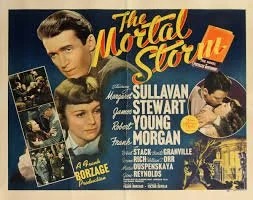
On June 14, 1940, MGM’s The Mortal Storm, directed by Frank Borzage, starring Margaret Sullavan, James Stewart, Frank Morgan, Robert Young, Robert Stack, Ward Bond, and the legendary Maria Ouspenskaya, had its premiere showing at Manhattan’s Capitol Theatre. Despite receiving exceptional reviews by the major critics of the day, this legendary classic is, 86 years later, largely unknown and thus rarely seen. I find this a crying shame, for The Mortal Storm is easily one of the most consequential films in all Hollywood history. Moreover, in the Hollywood of 1940, it took a ton of courage even to consider turning this anti-Nazi novel into a film, let alone an “A” production with a stellar cast. In addition, MGM head Louis B. Mayer (who happened to be the longtime head of the California Republican Party) knew full well this film would be banned throughout both Europe and South America by Adolph Hitler and his Third Reich.
Based on a 1937 work by the prolific British novelist/biographer/essayist Phyllis Bottome (pronounced Bah-TOME), The Mortal Storm takes place in a small university town (likely Kitzbühel) on the Southern German/Austrian border. At the beginning of the novel/film, Professor Viktor Roth, a much-loved instructor at the local medical school, is being feted by his students and colleagues in honor of his 60th birthday. (Professor Roth is played by actor Frank Morgan, best known for essaying the title character in the 1939 classic The Wizard of Oz.)
The party continues at the Roth home, along with his wife Emilia (Irene Rich), sons Fritz (Robert Young), Otto (Robert Stack). Rudi (Gene Reynolds), daughter Freya (Margaret Sullivan), and lifelong family friend Martin Breitner (James Stewart). All is happy. Then the family maid Mata (Esther Dale) bursts into the dining room, announcing that Adolf Hitler has just been elected Chancellor of Germany, and that 3 of the 4 sons are expected to attend a meeting of the party faithful. From that point on, all hell starts breaking loose; it turns out that Dr. Roth is a non-Aryan. Within the blink of an eye, Professor Roth becomes persona non grata
As important and consequential as it was, The Mortal Storm was not the first film dealing with the growth, danger, and perfidy of the Nazi Party and its leader, Adolf Hitler. That "honor” goes to the documentary, which goes to a 1934 oddball, quasi-1934-documentary, Hitler’s Reign of Terror, produced by Cornelius Vanderbilt, the great-great-grandson of the cruel American industrialist “Commodore Vanderbilt. The senior Vanderbilt (1794-1877) built a global shipping and railroad empire and, at the time of his death, was worth approximately $250 million – the equivalent of about $200 billion in today’s dollars.
Based on a fact-finding trip to Germany by the younger Vanderbilt immediately after Hitler had been elected Chancellor, this documentary contained newsreel footage of book burnings and other political atrocities. Upon its original release, the film was "slammed" by the German Embassy in Washington and was censored within America, largely because the USA's stance on Nazi Germany was still unclear. The documentary would not be unearthed and shown in public until 2013.
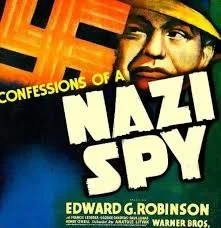
Confessions of a Nazi Spy (1939)
During Hollywood’s “Golden Age,” among the major studios (Paramount, Fox, MGM, Universal, Columbia, and Warner Bros.), the latter was, without a doubt, the most progressive, pro-New Deal of all. Its films were grittier; its stars more earthy, and most modern (for the time) kitchen scenes would have a photo of FDR on the wall. Also, the brothers themselves (Harry, Albert, Jack, and Sam [who died tragically in 1927, just before the release of The Jazz Singer]) were the most outwardly Jewish. As such, it should come as no surprise that the first film to have the word “Nazi” in the title was 1939’s Confessions of a Nazi Spy. Based on a best-selling book by a real FBI agent who broke up a real Nazi spy ring, this, the first explicitly anti-Nazi film of the US pre-war period, was directed by Anatole Litvack and starred Edward G. Robinson. George Sanders and Francis Lederer.
It was a dangerous movie to make. Many of the actors who still had relatives living in Germany changed their names for use in the film. Only 10 copies of the script were handed out daily. . . as opposed to the usual 125-150. The press office of the Third Reich let it be known that once Germany had defeated the United States, everyone associated with the Confessions of a Nazi Spy would be put to death. And in a highly unusual move, there were no credits - save the film’s title at the beginning; credits were only placed at the end. Despite being banned in Germany, much of Europe, and South America, it was a decided hit - both with the critics and at the box office. Like The Mortal Storm, nowhere did the words “Jew” or “Jewish appear. Like The Mortal Storm, nowhere were the words “Jew” or “Jewish spoken in Confessions of a Nazi Spy. It should also be noted that the brothers Warner closed their German distribution office in 1934, while MGM, the producer of The Mortal Storm, did not close its German operations for another 8 years.
Getting back to The Mortal Storm. When Dr. Roth’s 3 sons (stepsons, actually) leave the dinner party in order to obey their Nazi bosses, they ask Viktor and their friend Martin if they are for or against Hitler and the Nazis. Both give the same answer: “I believe that peace is better than war.” Now they are the enemy . . . along with Freya (Sullivan), to whom Fritz (Robert Young) has just announced his engagement. From this point on, things go from bad to worse for Victor, Martin, and Freya. Victor is dismissed by the university that had just lionized him, and is sent to prison. The charge? Being a “non-Aryan.” There, Dr. Roth will die of a heart attack. Martin pledges his lifelong love for Freya and, at the advice of his aged mother Hilda (Maria Ouspenskaya), makes plans to escape to Austria, where he should be safe from the Reich.
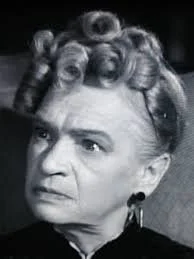
Ouspenskaya
A student of method acting guru Konstantin Sanlslavski in Russia, Ouspenskaya moved to the United States in 1922. An accomplished star on the European stage, she quickly became a star on Broadway. She also spent the rest of her life teaching “The Method” school of acting to such notables as Lee Strasberg and Harold Clurman, who in turn would teach Stella and Luther Adler, who would become mentors to such future stars as Marlon Brando, Robert Duvall, Diane Keaton, and Merrill Streep.
t was a dangerous movie to make. Many of the actors who still had relatives living in Germany changed their names for use in the film. Only 10 copies of the script were handed out daily. . . as opposed to the usual 125-150. The press office of the Third Reich let it be known that once Germany had defeated the United States, everyone associated with the Confessions of a Nazi Spy would be put to death. And in a highly unusual move, there were no credits - save the film’s title at the beginning; credits were only placed at the end. Despite being banned in Germany, much of Europe, and South America, it was a decided hit - both with the critics and at the box office. Like The Mortal Storm, nowhere were the words “Jew” or “Jewish spoken.
Getting back to The Mortal Storm. When Dr. Roth’s 3 sons (stepsons, actually) leave the dinner party in order to obey their Nazi bosses, they ask Viktor and their friend Martin if they are for or against Hitler and the Nazis. Both give the same answer: “I believe that peace is better than war.” Now they are the enemy . . . along with Freya (Sullivan), to whom Fritz (Robert Young) has just announced his engagement. From this point on, things go from bad to worse for Victor, Martin, and Freya. Victor is dismissed by the university that had just lionized him, and is sent to prison. The charge? Being a “non-Aryan.” There, Dr. Roth will die of a heart attack. Martin pledges his lifelong love for Freya and, at the advice of his aged mother Hilda (Maria Ouspenskaya), makes plans to escape to Austria, where he should be safe from the Reich.
A student of method acting guru Konstantin Sanlslavski in Russia, Ouspenskaya moved to the United States in 1922. An accomplished star on the European stage, she quickly became a star on Broadway. She also spent the rest of her life teaching “The Method” school of acting to such notables as Lee Strasberg and Harold Clurman, who in turn would teach Stella and Luther Adler, who would become mentors to such future stars as Marlon Brando, Robert Duvall, Diane Keaton, and Merrill Streep.
In order to help support her acting school, Ouspenskaya went to Hollywood, where she would find character roles in a handful of movies. All in all, she appeared in about 15 films; most of her roles lasted less than 10 minutes. And yet, she was nominated for best supporting actress in two of them: 1937’s Dodsworth and 1940’s Love Affair. Strangely, her best-known role was that of Maleva in The World Man (1941)
After several months of being away in Northern Austria, Martin returns to Germany, surprising Freya, who did not even know whether he was still alive. He tells Fraya that he wants her to go with him to Austria; that the only possible way to get there safely is skiing through a pass. Hilda marries them in name only and sends them on their way. When the Germans discover that the two are skiing away, Freya’s brother Fritz is given the order to take a small squad, intercept, and kill them before they reach Austria. Although Fritz attempts to get out of the assignment because it is both inhuman and deeply cruel to order him to kill both his sister and his lifelong friend, the officer in charge reminds him in no uncertain terms that his obligation is to the Führer, not his family. Fritz obeys, takes an armed detachment (one of whom is Franz, played by Ward Bond) down the mountain, and successfully shoots Freya. The film ends with Martin carrying Freya’s body into Austria. The film's final words are a poignant, spoken word quotation from Minnie Louise Haskins' 1908 poem The Gate of the Year:
"And I said to the man who stood at the gate of the year: 'Give me a light that I may tread safely into the unknown.' And he replied: 'Go out into the darkness and put your hand into the Hand of God. That shall be to you better than light and safer than a known way."
Phyllis Bottome (1884-1963), author of The Mortal Storm, was a prolific writer, devout anti-Fascist, and both a student and biographer of the eminent Austrian medical doctor/psychotherapist Alfred Adler. (Adler was the founder of the school of individual psychology. His emphasis on the importance of feelings of belonging, of relationships within the family, and birth order set him apart from Freud and others in their common circle.)
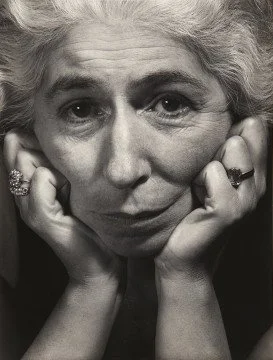
Phyllis Bottome (1884-1963)
In 1917, Bottome married Alban Ernan (A.E.) Forbes Dennis, a British diplomat working first in Marseilles and then in Vienna as Passport Control Officer. In reality, this was a cover for his real role: he was MI6 (The British version of the CIA) Head of Station, with responsibility for Austria, Hungary, and Yugoslavia. When they moved to Kitzbühel in the early 1930s, they created a school for boys (called “Tennerhoff) based on the teaching of languages and the individual psychology of Alfred Adler. One of her favorite students was a young British lad who had been exiled to Europe for his inability to get along with his peers or teachers. His name was Ian Fleming. Bottome saw something special in the boy and urged him to start writing. Eventually, Many years later (1946), Bottome published her only spy novel, The Lifeline (sometimes listed as The Life-Line). Set in Nazi-occupied Austria in 1938, the book tells the saga of an Eton schoolmaster, Mark Chalmers, who gets drawn into the anti-Nazi resistance after agreeing to deliver a message for British Intelligence. The book is notable as a precursor to James Bond; not only because Bottome was both his teacher and mentor, but because her protagonist shares similarities with Bond, exploring themes of duty, courage, and morality in wartime espionage. Maria Ouspenskaya and Phyllis Bottome have one great thing in common: the one has a legacy in all the actors she helped spawn; the other a literary character who is still hard at work.
The Mortal Storm is both a film and a novel that should - even after all these years - make us feel angry and fearful, energized and unwilling to just silently sit back and let evil people commit acts of evil. It/they are a warning shot across the bow of history; an admonition that we can.
I urge you to see this film or read the novel at your earliest opportunity. Their depiction of past events just may give you added strength and understanding for today and tomorrow.
You will also better understand how works of art can be consequential.
Copyright©2026 Kurt Franklin Stone