
#1,073: We Were ALL Slaves in the Land of Egypt
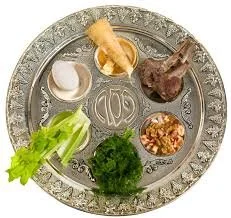
In about 48 hours, Jewish families, friends and communities the world over will begin the celebration of Passover (Pesach). By any stretch of the imagination, it can be both the most enjoyable - and most complex - of all Jewish festivals. And, depending on how good the cooks, chefs, or caterers in your neck of the woods are, it can also be the most delicious. Pesach, of course, commemorates the ancient Hebrews’ exodus from slavery to freedom after being under the thumb of the ancient Egyptians for some 430 years. It can be a rather complex holiday; G-d knows that for some of us, its preparation - the scouring of the kitchen, replacing of the plates, pots, pans, and utensils, the shopping for kosher le pesach (“kosher-for-Passover) foodstuffs - can begin upwards of a week or more before the candles are even lit for the first Seder.
And yet, Passover has a simple yet incredibly seminal message to deliver not just to Jewish folks but to people from Afghanistan to Zimbabwe: to wit, that slavery is a supreme sin, and freedom is the most basic of all human rights. Throughout the haggadah - the booklet used at the Passover Seder - the message “We were slaves to Pharaoh in Egypt’ is repeated in one form or another. It is repeated in both positive and negative forms: to remember and not to forget. This is not some mere suggestion; it is on a par with any of the Divine Commandments (mitzvot) and is the most frequently repeated commandment in the Torah (the Five Books of Moses): 36 times. It is an essential, perhaps the essential value for both Jews and non-Jews alike: to work for justice at all times on behalf of oppressed people, based on the awareness that we were once slaves . . . whether in Egypt, Spain, Turkey, Russia, Iran, the United States, England . . . or anywhere else on the planet.
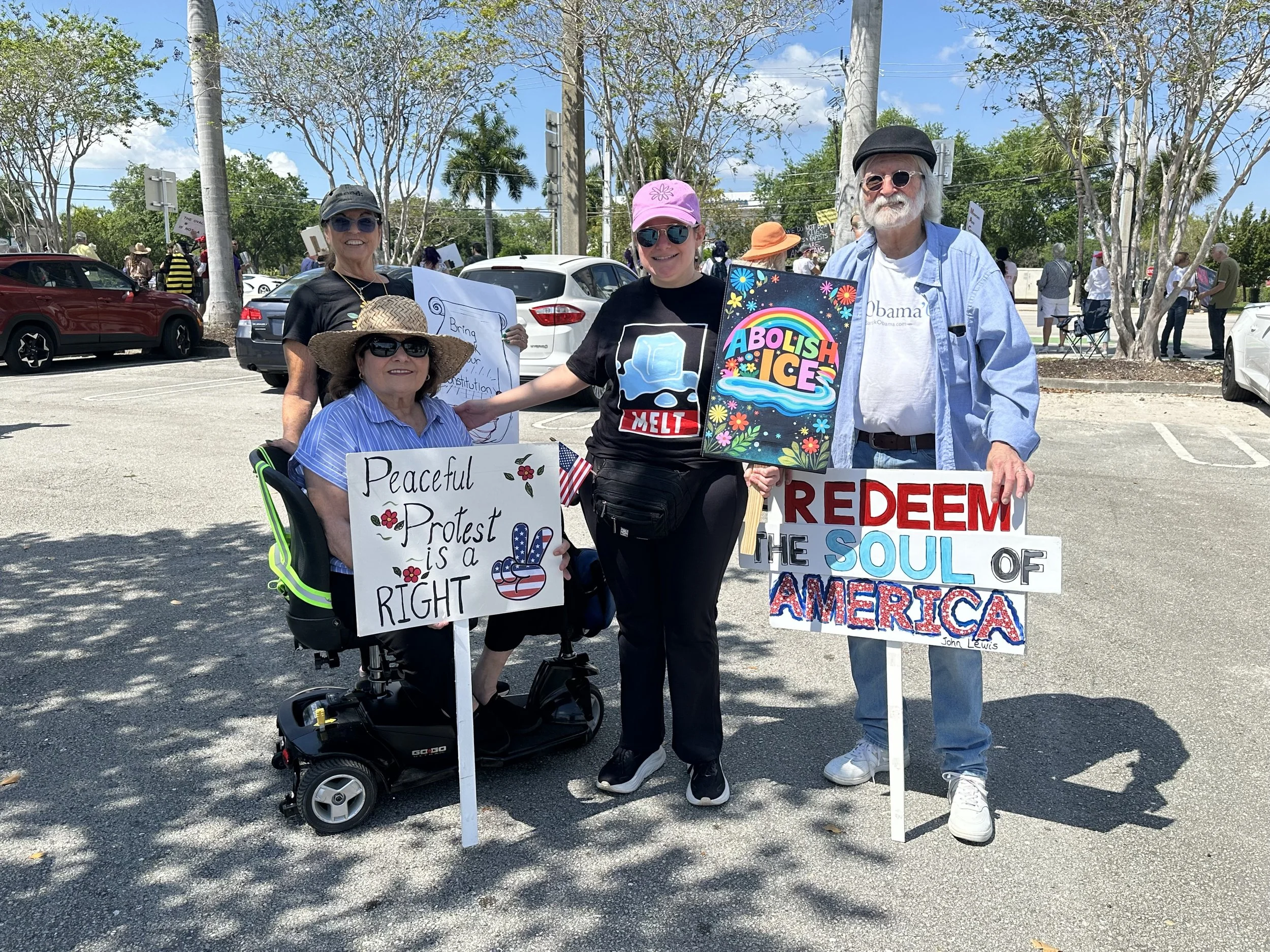
Annie, Nurit and Moi
And whether the more than 8 million people who just yesterday attended “No Kings” rallies in the 50 states knew it or not, our gathering, sign-waving, singing, and protesting was, as we would say in Hebrew, zecher le'yetziat Mitzraim: “a remembrance of our going forth from Egypt” . . . both a literal remembrance from the past, and a figurative spur for the future. The gathering Annie, Nurit, and I attended yesterday in Coral Springs along University Drive was incredibly energizing. Annie carried a placard emblazoned with the words “Peaceful Protest is a Right (along with a red-white-and-blue hand giving the two-finger “peace” sign); Nurit wore a black T-shirt with a melting ice cube that she had designed; mine had the immortal hope of the late Rep. John Lewis: “Redeem the Soul of America.”
Over the past several decades, some fundamentalist Christians have begun hosting Passover meals at their churches. To them, it is a means of bringing the flock closer to Jesus, who, as the Christian Bible tells us, celebrated Pesach with his disciples during the Last Supper, which occurred immediately prior to his crucifixion. As a Jewish person, he would have quite obviously followed the tradition of commemorating the Exodus. To many Christians, Jesus is seen as the unblemished “Lamb of G-d,” the broken Afikomen symbolizing his body, and the third of the four cups of wine (the Cup of Redemption) representing his blood.
Although the Jewish and Christian interpretations of that Passover Seder may differ, the underlying message of that seder itself has not: the universal need and necessity of all people working towards the redemption of those who are enslaved - whether in body, mind, spirit, or soul. At this season, in which Jewish people observe Passover and Christians celebrate Easter, I get more questions about the nature of Judaism than at any other time of the year. What follows is both a brief explanation of the nature of Jews and Judaism, and a prayer for better understanding. I came across this piece some time ago, and have no idea who its author is . . . but THANK YOU:
Judaism is a religion. But it is not only a religion. And you don’t need to believe in G-d to be Jewish. You don’t have to daven mincha (pray the afternoon service) or keep a kosher home or light candles on Shabbat (Sabbath) or study Torah or face Jerusalem to pray.
Because Judaism is also a peoplehood. A memory. A language that echoes even when we don’t speak it. A rhythm that pulses even when we don’t keep time with it.
Israel is our source and where we took root - not just a place on a map, but a landscape of story. It lives in the names we carry, in the lullabies we don’t remember learning, in the way certain words catch in our throats. It lives in ancient coins with Hebrew inscriptions pulled from the earth, in shards of pottery, in prayers pressed into stone, in arguments that never really end.
We are a people — magnificent, far-flung people — from the steppes of Russia to a shtetl in Poland, from the deserts of sub-Saharan Africa to the highlands near Addis Ababa, from Kaifeng to Cordoba, from Baghdad to London, from Casablanca to Brooklyn, from Buenos Aires to Berlin, from a crowded table at Russ & Daughters to a quiet apartment overlooking the Western Wall.
We have lived everywhere. We sound different. We look different. We practice differently. We vote differently. We argue differently. We disagree — loudly, sometimes painfully — because that is what living people do.
But beneath all of that, there is a through-line.
We have been cast out. We have been othered. We have been translated and mistranslated, renamed and erased, and rediscovered. We have learned how to live between worlds — sometimes by choice, often not. We are, many of us, a little like mermaids — fluent in more than one element, never fully belonging to just one.
We are survivors. But survival is not the whole story. We build. We write. We joke. We argue. We fall in love. We make art out of exile. We make meaning out of rupture. We take what is broken and we do something with it. And we don’t need anyone to tell us who we are — or what defines us. Because there is no single answer. There never was.
There are Jews who find God in the silence of early morning prayer.
And Jews who find meaning in protest, in justice, in repair.
And Jews who find themselves in food, in family, in language, in memory.
And Jews who are still searching, still questioning, still unsure — and that, too, is part of it.
We don’t need anyone to tell us who is a “good Jew” or a “bad Jew” or how to be a Jew correctly.
We have our own moral compasses.
They are not identical. They were never meant to be.
And maybe that’s the point.
A people that has crossed deserts and oceans, survived empires and expulsions, argued across centuries, and still shows up to the table — however we define it — is not fragile.
We are complicated. We are contradictory. We are alive.
And we are still here.
Wishing one and all a meaningful Passover and an Easter that both restores and reenergizes. Remember, we are here, together in partnership: divinity with humanity; those who pray right to left with those whose devotionals move from left to right; those who were once enslaved with those who are still bound in the shackles of subjugation.
May we always remember the lesson of Egypt . . . May we never forget the power we have when we all work together.
Copyright©2026 Kurt Franklin Stone & Anonymous