
#1,067: Profound Wisdom From Ben Zoma (Ben Who?)

POTUS & Rep. Jonathan Jackson (D-IL)
This past Thursday, POTUS attended the annual “National Prayer Breakfast.” For him, it was his sixth time. Not surprisingly, he was on the agenda, scheduled to give a brief address - as all presidents do - on the nature and importance of prayer. But what he did and said was neither brief nor uplifting. Over the course of 75 minutes, POTUS, whom late-nite talk show host Jimmy Kimmel referred to as “Scammy Faye Bakker” for the comedian’s opening monologue, rambled on about this and that, and even got in a shot at House Speaker Mike Johnson for “saying grace before eating lunch.” IT’s diatribe was so singularly lacking in compassion or spirituality - let alone even a smidge of humanity - that Illinois Representative Jonathan Jackson (the son of the Reverend Jesse Jackson and godson of the late Reverend Martin Luther King, Jr.), got up and, standing inches in front of our Beloved Pouter Pigeon, asked G-d to get POTUS to "do the right thing.” As much wisdom as there was in Rep. Jackson’s heartfelt plea, one wonders if G-d has given up on our Fondling Father. (You can watch Rep. Jackson’s 3-minute speech on YouTube.)
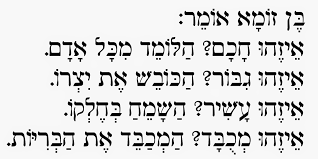
The Wisdom of Ben Zoma (In the original Hebrew)
Had I been at the National Prayer Breakfast and given the honor of saying a few words, they would have undoubtedly been the wisdom of a second century (CE) scholar named Shimeon ben Zoma. Although he never carried the official title “rabbi,” Ben Zoma has long been lionized for his extraordinary erudition. Without question, his best-known piece of wisdom is found in the rabbinic work known as Pirkei Avot (פִּרְקֵי אָבוֹת), translated variously as either Chapters of the Fathers or Ethics of the Fathers. Found in the Mishnaic tractate Nizikin (נְזִקִין - “Order of Damages”), it is the only one of the six tractates in the Mishnah with almost no laws, consisting instead of short statements of advice, ethics, and wisdom. Ben Zoma’s wisdom, found in chapter 4, verse 1, asks - then answers - the following questions . . . thereby teaching one of the most precious and eternal lessons in human history:
Who is wise? The one who learns from everyone, for as it is said: From all who have taught me have I gained understanding. (Psalms, 119:99).
Who is mighty? The one who subdues his/her [evil] inclination, for as it is said: “The one who is slow to anger is better than the mighty; and the one who rules their spirit than the one who conquers a city. (Proverbs, 16:32).
Who is rich? The one who rejoices in his/her lot, for as it is said: “You shall enjoy the fruit of your labors, you shall be happy and you shall prosper.” (Psalms, 128:2). “You shall be happy” in this world, and “You shall prosper’ in the world to come.”
Who is the one who is honored? The one who honors his/her fellow human beings, for as it is said: “For I honor those who honor Me, but those who spurn Me shall be dishonored. (I Samuel, 2:30)
And while we’re at it, a further bit of wisdom from the sage Hillel, again from the work The Ethics of the Fathers, this time chapter 1:14: Rabbi Hillel used to say: If I am not for me, who will be for me? And when I am for myself alone, what am I? And if not now, then when?
Tradition also ascribes to Hillel (ofttimes referred to as “Hillel the Elder”) the Jewish version of the “Golden Rule”: That which is hateful to you, do not do to your fellow human. That is the entire Torah. The rest is commentary. Go learn. One notices that his version of this time-honored homily is the precise inverse of what most know to be the Golden Rule. Think about it: if one is a masochist - relishes being treated like a dog – that would give him/her the right to treat others in that fashion. Perhaps, at root, that’s part of what’s wrong with IT . . .
Happily, the teachings of sages like Ben Zoma and Hillel (and many, many others found in The Ethics of the Fathers), have long been translated into English and just about every other language on the planet. The wisdom they teach is simple to comprehend, universal in scope and truly, truly inspirational.
What we need now, more than ever, are men and women in positions of leadership who are both wise and inspired, instead of those who are merely “wise guys.”
Copyright©2026 Kurt Franklin Stone